I am Mog Anarchy, and I like to play games. Whether they are old, new, retro, modern, online, offline, console, computer, critically acclaimed or notoriously bad. Here on my blog, I rant about, review, trash talk, praise and generally talk about all of my favourite and least-favourite games. I also write my own guides on how to accomplish tricky tasks, show off my creative endeavors and challenge myself with crazy in-game tasks. I also have a bunch of gaming merchandise which I am glad to show off. So drop me a comment, I love hearing your questions, criticisms, comments and general gaming discussions. :)
What would you get if you threw Harvest Moon, Rune Factory, Minecraft, Terraria and Animal Crossing into a blender, filtered it through an 16-bit retro sieve and served it on a Steaming indie community buffet table? Well, asides from the confused looks from the guests reeling from the pile of crushed cartridges and discs emitting smoke - it's likely someone would mention they'd rather be at home playing Stardew Valley.
Stardew Valley is a 2016 RPG/farming simulator game developed by Concerned Ape and published by Chucklefish on Steam, and later ported to the Xbox One, PS4, PS Vita, Android and Nintendo Switch. The game begins with a player creation screen in which you can customise your character avatar by changing their hair style, hair colour, eye colour, clothing and accessories such as beards or glasses. You can also name yourself, your farm, your favourite thing and choose your preference between cats or dogs. You can also choose between 5 different farm layouts, each of which is tailored to a specific play style or the focus on one of your characters’ main skills.
Unlike Harvest Moon however, you aren't limited to just farming to progress and generate income. Your five skills, which can be advanced by simply using them day to day are farming, foraging, fishing, mining and combat. Farming focuses on growing crops and raising livestock, foraging focuses on collecting wild fruit and herbs and chopping trees and logs for lumber, fishing is exactly what it's name suggests, using your fishing rod and also crab pots to catch fish and seafood, mining focuses on digging up ore and gemstones and combat involves using swords, daggers, clubs and slingshots to fight wild monsters in specific areas. Each of these skills can be used to earn you money, by selling whatever you grow, harvest, pick, chop, catch, dig up or by selling monster spoils and treasure - and whether you choose to focus on one, a mixture of several or even all five is entirely up to you.
The storyline of Stardew Valley opens with your player character working a dead end, soul-sucking repetitive job at the evil Joja Corporation before he or she remembers their grandfather left them a sealed envelope as part of his will, which he instructed you to open when you were in need of a change. As it turns out, your grandfather left you the deed to his old farm and his cottage - so naturally you move in and attempt to clear it up and make a go of living off the land.
The most impressive aspect of Stardew Valley in my opinion is the fact that Concerned Ape, the development studio is literally one person. That's right, every aspect of the game’s development was done by the same person, Eric Barone. The script, programming, art, sound and animation - everything was done painstakingly by hand over the course of a four-year development period by Eric himself, working out of his home in Seattle. To this day, Eric still takes time out of his day to answer questions from players and fans, and once-over hand-restored several players’ corrupted save files.
Unlike the majority of video games that are wholly driven by progression, scoring or the amount of money you can make in the shortest space of time, Stardew Valley shuns this in favour of encouraging players to play at their own pace, to take their time exploring, experimenting and making friends with the residents of the local town. There aren't any major expectations hanging over your head, so whether you want to build a fully automatic blueberry factory and roll around in your profits or spend a whole day walking through the forest picking flowers - you're welcome to play exactly how you please.
For completionists like me, there are some goals to work towards but the majority of them are self imposed tasks. There is the obvious challenge of maxing out your skills, which will come naturally through gameplay if you experiment with all of the different tools - and there is also the Community Centre. There are two large buildings within the town of Stardew Valley, the run-down and abandoned community centre and the large and intimidating Joja Supermarket. It is up to you who you work with. The Joja route is noticeably easier as all it requires it for you to raise a set amount of money, whereas the Community Centre encourages you to try different things by asking you to create “bundles,” i.e. a bundle of ocean fish, a bundle of summer crops, a bundle of smelted metals. Ultimately they lead to unlocking the same rewards - such as rebuilding a broken bridge, fixing a mine cart or opening up a bus route in order to allow you to access new areas. Each route also unlocks its own respective achievement or trophy and related in-game items.
My biggest irritation with Stardew Valley is its hands-off approach. Unlike many modern games that have a tendency to hold your hand throughout the game, Stardew Valley throws you in with little to no instruction whatsoever beyond the controls. There is no tutorial, no on-screen hints or any beginner quests that could offer first time players an idea of where to begin. And as the game itself is so broad with a vast amount of different things you can do, it lead to me feeling very overwhelmed - thus once I finished my first month, I restarted the game not once, not twice, but four times - as it took that long for me to feel comfortable and confident enough that I'd learned enough of the game to actually enjoy it. Even adding a tutorial or beginners mode or adding the option to enable hints or tutorial quests would solve this issue, in my opinion. Personally I also despise games that guide you through the game with you on a set of toddler reins, but sometimes there is such a thing as stepping away a tad too far. Some players may love learning through trial and error, but I'm a needy sort who needs constant validation that what I'm doing is what I'm supposed to be doing!
There’s Poop in My Soup is a physics-based arcade game by K Bros. Games released on Steam in March, 2016. The premise of the game is as such - you play a little man who is perching on a rooftop with a belly full of poops - using WASD you can aim your crosshair and fire your poops with the space bar. Once you have unlocked them, you can also activate level specific power-ups using F. Revolving around the arcade-style scoring system you are encouraged to build up multipliers by hitting multiple targets with your poop or hitting consecutive targets without missing.
Each level comes equipped with its own “To Poo” list, which is a list of riddles that hint at what you should be aiming at. These can range from landing a fresh turd on the head of a hipster or punk rocker with a mohawk to managing to ricochet your poops using awnings to hit speeding taxi cabs. There are also somewhat grosser tasks such as replacing a forlorn kid’s dropped ice cream with your own chocolate soft serve, pooping into soup, rice and coffee (depending on the location) getting revenge on dogs by pooping on them for a change and of course, landing a stinker in a baby carriage.
As you tick off the targets on your list, you will be rewarded with larger amounts of “ammo” per level and more uses of your F key powerup. These powerups vary from stage to stage - the New York one being a giant bowel ball that explodes into thousands of tiny turds, the China one being explosive fireworks that rain down on the unsuspecting people below and the France one being a constant stream of diarrhea for 60 seconds that can be used to drown the city with your decadence.
Using the Steam Workshop you can download skins for your character - changing him from a naked guy with exploding orange hair into the likeness of YouTubers and political leaders, including one named Donald Dump… What was disappointing for me was that there was no in-game avatar editor - I would have loved to have made a likeness of myself… Nothing would make pooping on strangers funnier than doing it in the guise of yourself. But no such feature exists - instead it’s limited to those with programming knowledge who download the necessary editing tools.
A very simple premise is also oddly addictive - and includes some challenging score targets to hit and Steam achievements that involve racking up massive amounts of pooping points. Naturally as this is a 79p casual Steam game, it’s designed to be played in short bursts, and if you tend to gulp games, like I do - you can hammer out all of the tasks and achievements in just under an hour - but it’s a fun little time waster and great fun to show to your squeamish friend who is really grossed out by poop.
Oi you lot, in the mood to be creative and win some Steam games? In honour of hitting my 1500 subscribers mark on YouTube, I’m running a little competition… A creative writing competition, to be exact. I want to see your amazing creativity channeled through your keyboards and presented in the form of lovely little stories, poems and plays... EVERY entrant will receive a Steam key! I bought a big bundle of random keys (admittedly I have no idea what they are until they are redeemed, I can’t guarantee they’ll be triple A titles) - and thus have plenty spare! The one(s) I like the best will receive either a gift card or Steam wallet gift… or I’ll buy ‘em a game from their wishlist. The only requirement I'm asking is that you make the main character of your story either me, Cat Chaos or Charm Agony. You may include all 3 of us, only one of us, any combination. Can be 1st or 3rd person and can be a piece of short prose or written in a script/play format with just dialogue or even some poetry! Feel free to include your own original characters or any characters from games/comics/movies etc - feel free to be as realistic or as nonsensical as you want! And sure, if you really can't control yourself, I'll even allow more *ahem* adult content. I'm not enforcing a strict word count limit or anything like that - but when I say “short,” I mean don't write half a novel. A couple of pages will do fine - double that if you're writing a script/screenplay style thing to account for the spacing. I would like to read some of the entries out - perhaps in character, or as all of my characters doing a sort of “dramatic reading” type video or several videos… And if I *really* take to your idea… I may steal it and rework it into a skit! So bear that in mind, you lot! Make sure you get your entries in by the 3rd of July!
Ah bread, one of the staple foods of the western world. Cheap, sustainable and so versatile! Whether it’s sandwiches, burgers, hot dogs, toasted, grilled or dipped - it’s safe to say the vast majority of us couldn’t imagine life without bread. But how about if sentient slices of bread began breaking into your home and toasting themselves on various household appliances? Driving you to a paranoid breakdown where you end up in therapy? Well... I Am Bread is a 2015 physics-based puzzle adventure game developed by Bossa Studios and released on PC, Xbox One, PS4 and mobile devices.
Using either the keyboard or a controller, you take control of a sentient piece of bread who desires to be toasted. Each of its four corners has a button configured to it and thus you must learn how to maneuver around using physics, balance and timing. Naturally the act of transporting bread to the toaster or other heating device is complicated by numerous hazards present throughout each stage. The obvious ones are falling to the floor, getting covered with ants, dropping into a sink full of water, getting covered with dirt, debris, spills, stains and used band aids - and my personal favourite for obvious reasons, slipping off the side of the counter into the cat litter tray.
Getting your slice of bread dirty reduces its “edibility,” a percentage bar that is present in the top-left corner of the screen. Ideally for perfect toast, you will reach the heating device with 100% edibility and proceed to toast yourself evenly on both sides, making sure you don’t overcook and burn. Upon completion of each level you will be graded from F to A++, depending on how quickly you managed to toast yourself, how edible you ended up and varying other level-based factors. While the physics of the bread itself are fairly realistic - it’s difficult to stand up on end as you’re floppy, coating yourself in jam makes you sticky and getting covered with butter makes you slippery - most slices of bread are unable to grip to walls and surfaces in order to reach new areas and cross obstacles and hazards. At the top of the screen you have a grip meter - which depletes for as long as you are clinging to a surface or holding onto an object. If this meter runs out, you will plummet to whatever lies beneath you - often something gross or messy that will instantly knock down one’s edibility.
The bread into toast levels are only one gameplay mode however - playing as the character known as “Wholemeal” is the story mode. In addition, there are numerous other gameplay modes in which you take control of different bakery products, including a bagel, a baguette, and a crispbread cracker. There are also other modes that nod to other Steam franchises such as Team Fortress 2 and Goat Simulator and an entire mode parodying the Star Wars series.
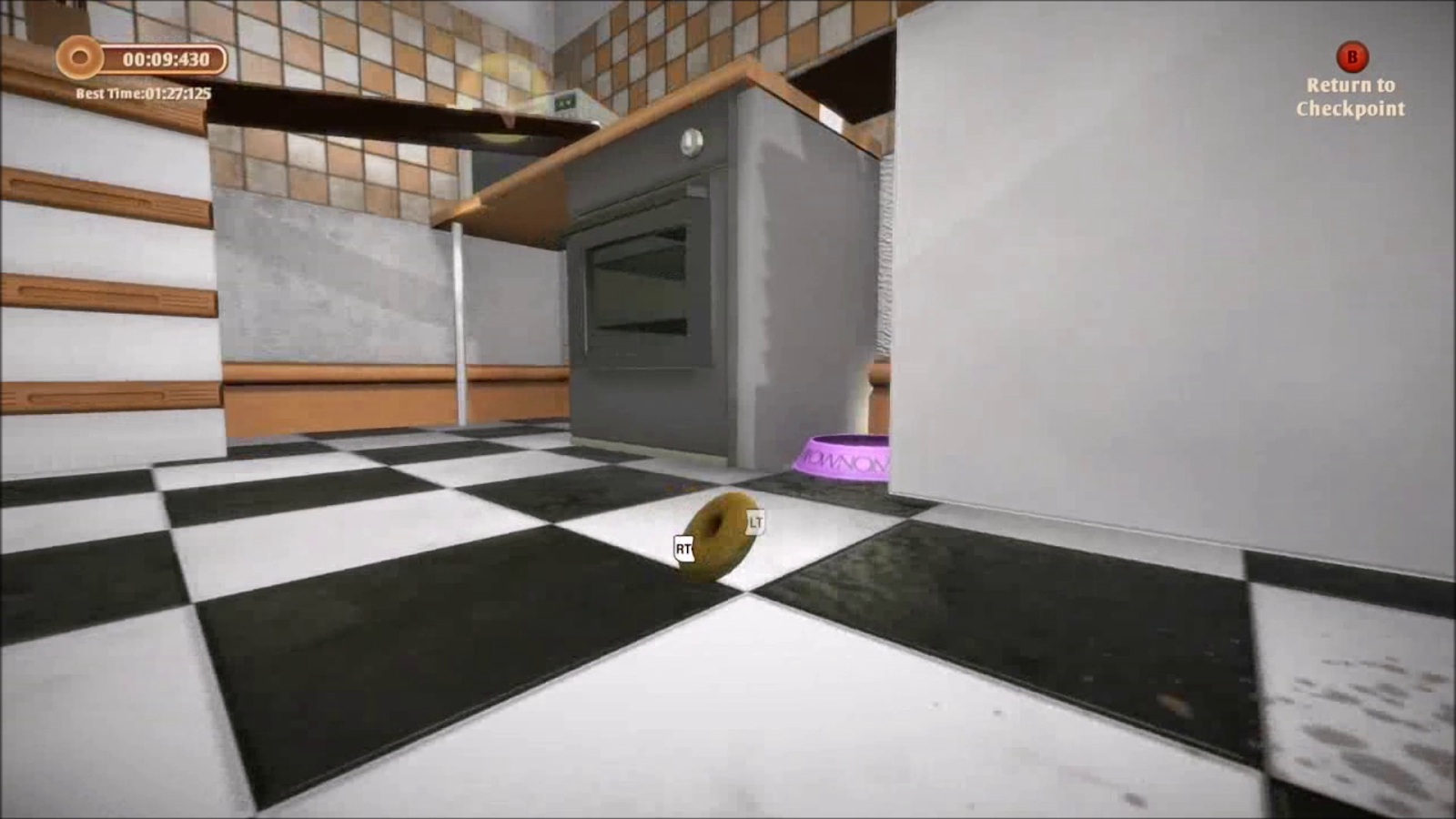
The bagel mode is called Bagel Race and is exactly that - using the two control points on your bagel you must roll yourself through the course, which is marked by glowing checkpoints. In addition to having to master steering and maneuvering, the bagel requires some serious rhythm and patience in order to learn the best way to build up speed and complete the course in the frankly cruel times the game sets for you.
The baguette mode is known as Rampage Mode - in which you are given a few minutes to roll around and smash everything in sight - often there’s precariously placed towers of glasses and objects lined up in a domino formation just waiting for your crusty self to plow through. However unlike the bread and crispbread cracker, the baguette only has two “corners” to control, so you often end up either rolling along your side or flipping over end to end. Smashing objects consecutively leads to increasing score multipliers which naturally awards you with higher grades upon completion.
The crispbread cracker mode is known as Cheese Hunt - and instead of having an edibility meter, you have an integrity meter. The crispbread cracker can smear itself through oil, grease and ants no problem - but fall from too high of a drop or hurtle into a breakable object like a plate or butter dish and you will begin to crack and shatter until you fall to pieces. The object of this mode is to find the pieces of cheese that are hidden throughout the level. The scoring aspect is all based on time, so once you’ve explored the levels top-to-bottom and have worked out the best route to nab all of the pieces in the fastest time, the only obstacle in your way is your own fragility. The cracker controls in a very similar manner to the bread, but is a lot stiffer and rigid - and of course, will break if dropped, where the bread’s inherent sponginess cushions blows but easily absorbs liquids.
The Team Fortress 2 mode invites you to create your own Edible Sandvich Device - navigating around familiar territory and even using classic objects from the game such as the Inflatable Balloonicorn and the sleeping Heavy to avoid touching the floor and make it to the fridge where the other ingredients are.
The Goat Simulator homage replaces the baguette in the Rampage Mode, instead renaming it to RAM-page Mode - and mapping four buttons to each of the goat’s limbs. It’s a great tribute to the frankly hilarious and impossible ragdoll physics of Goat Simulator itself and the goat really has some realistic weight to it - such as the back legs being a lot sturdier and stronger to move yourself around with than the front legs. While not being able to control it directly, the goat’s trademark tongue also flops around and can grip onto objects for extra destructive fun.
The Starch Wars is a space shooter simulator very similar to the likes of Lylat Wars, only set in the I Am Bread universe and the zero-gravity mode is exactly how it sounds - you control a slice of bread who is wearing a jetpack - and all of the ordinary level items, obstacles and hazards are now floating around in the air. I’m not a fan of zero gravity mode whatsoever - call me a sucker for integrity but I demand some believable aspects to my anthropomorphic bread simulator game, thank you very much. There is also a free roam mode, in which you can explore the levels to your heart’s content - finding Easter Eggs and secrets you may have missed on your first run through of a level as you were too busy watching the clock and clinging to the skirting board for dear life so as not to touch the dirty socks on the floor. Each level includes at least one hidden achievement and there are truly some bizarre and oddly hilarious things you can do, despite being a piece of bread. Can bread drive a car? Of course it can. Can it ride a skateboard? Yup. Can it soar through the air while stuck to the side of a rocketship? I’ll leave that one up to you to find out.
I recommend I Am Bread to anybody who is a fan of the more off-the-wall and absurd indie game scene on Steam, anyone who is a fan of hilarious and nonsensical gems like Goat Simulator, Octodad and Viscera Cleanup Detail - those of us who are spurred on by the impossible challenges set for us by fiendish developers who mock us if we score less than a B grade… For those of us who like to master peculiar control schemes and who like to think outside of the box… the bread box, that is!
Viscera Cleanup Detail is a 2015 first-person janitorial simulation game released on Steam. You assume the role of a janitor who works for the company Aerospace Sanitation Inc. - a company that specialises in cleaning up the gory remains of homicide, suicide, alien invasions, bloody rituals, mutations etc - and as you learn by reading clues sprinkled throughout the game, has a tendency to cover up the truth using somewhat underhanded methods. You control the janitor from a first person perspective and have a wide array of tools at your disposal for cleaning up an area. Your main tool is your mop - which is used to clean up blood, soot, dirt etc. Your mop must be cleaned regularly or you'll end up making more mess. You also have a broom for sweeping up bullets and trash, biohazard bins for collecting body parts, buckets for rinsing your mop, a laser welder for sealing up bullet holes and a huge incinerator for destroying all waste items. The objectives for cleaning an area will vary by location but all require that you dispose of any dead human and alien bodies and remains, incinerate trash and waste items, mop up any blood or liquid spills and repair any broken items. Some levels require you to scrub graffiti from walls, reload gun turrets, tidy up parcels or barrels into a designated area and planting new seeds to replace dead plants. Viscera Cleanup Detail can be played alone, split-screen co-op with up to 4 players or can be played online with up to 24 people to a server. Larger levels are easier when tackled with a partner or group, as each person can assume a different role or tackle a specific area. The levels range in size and length from anything to around 45 minutes all the way up to 3-4 hours. Obviously larger levels can be saved and returned to at a later time and the game will periodically autosave to ensure you don't lose any progress. The levels are themed around science fiction and horror games and movies - namely games series like Dead Space - where a futuristic setting would be ruined by all the potential death, blood and gore. Other levels feature obvious references to classic horror films, such as Overgrowth referencing Predator and Frostbite referencing The Thing. All of the employees found in the levels will have been killed in some horrific manner, such as being skewered, decapitated, eviscerated, skinned, burned or liquidised and it is up to you to clean up the mess left behind. As boring as a cleaning simulation game may sound, Viscera Cleanup Detail is actually very addictive. It's perfect for people like me who are completionists and perfectionists - as reading your results and learning you didn't miss a single thing is immensely satisfying. It's fun to play co-op, far more fun than working together on housework as you can balance your different skills and playing styles to improve your overall efficiency and beat your previous times and scores over and over again. And for the real obsessives, each level features a bunch of paperwork where you can use a mixture of investigation and educated guesswork to determine what happened in that level and how each employee died in order to earn bonus points. And for players who enjoy exploration and uncovering mysteries, a lot of levels feature secret areas and unique items (most of which are references to other games and movies) that can be collected as trophies. Also hidden in levels are literal Easter Eggs and notes from a fellow janitor Bob who went rogue. Tracking Bob down using the clues found in his letters also awards you a bunch of unique items and unlocks a large secret area to explore. Trophies and items you want to keep can be transferred to your own personal office - a player home like area you can decorate using physics control. You could hoard weaponry, unique items or if you're a total psychopath like Bob, severed heads and limbs. Your office comes decked out with 4 rooms and several large shelves you can fill up with your level spoils. As the game is rather large and frequently features a large amount of objects on-screen, glitches are prone to happening frequently, usually involving physics or items becoming stuck in the walls - though to me, these are more funny than annoying. To make up for its faults, the game does not penalise you if you need to use console commands to work around a glitch. Viscera Cleanup Detail has 3 DLC packs, each of which can be played as part of the main game or as standalone games. House of Horror is Halloween themed and is essentially a gigantic mashup of 1980s slasher movies. Santa’s Rampage deals with the aftermath of good ol St Nick going on a murderous rampage in his workshop and Shadow Warrior is based around the ninja game of the same name, cleaning up a pagoda full of dead Yakuza. It's a fun little game and surprisingly cheap - when I first picked it up, I certainly didn't think I'd be sinking over 200 hours into it - nor did I know it would become a major staple of my co-op gaming sessions with Shelly and Ash. And I haven't even tried any user submitted stages from the Steam Workshop yet! I'm going to be mopping up blood for a long while to come...
Octodad: Dadliest Catch is a 2010 physics-based sandbox adventure game that was originally released on PC and Mac and later ported to the PS4, Xbox One and Wii U. It was developed by Young Horses, a company founded by an independent group of university students who originally released Octodad as freeware software online before working on this updated release. The core gameplay revolves around the title character, Octodad carrying out his mundane suburban lifestyle, playing with his two children, doing yard work and going grocery shopping - all of which is complicated massively by the fact he is an octopus in a 3-piece suit disguising himself as a human. Each stage is broken up into small manageable tasks that are displayed at the bottom of the screen and in order to complete them you must control each of Octodad’s tentacles independently - his left “leg”, his right “leg” and his “arms.” His suction cups can be used to pick up items and used to grip walls and surfaces in order to climb. His flexible invertebrate body can also be used to your advantage to maneuver through tight spaces and tunnels. Co-op mode works in the same way, except you and your partner each control different parts of Octodad’s body and must work together. This, naturally is more difficult than it sounds as Octodad clearly lacks a skeletal structure, his limbs are very floppy and pliable and are heavily affected by gravity and in-game physics. You must learn to move all of his limbs simultaneously in order to move around and complete the various tasks while ensuring you don't make too much of a mess or attract enough attention that onlookers don't twig you're actually an aquatic impostor. Despite the obvious difficulty and awkward controls - the game for me never became frustrating - it remained hilarious from start to finish. Managing to traverse the produce aisle *without* slipping on banana skins and destroying all of the displays became totally optional - as more often than not, it was fun to make a bit of a mess and wobble around all over the place. This of course is made so much funnier by the fact that both your family and members of the public remain completely nonplussed by your octopus actions. Octodad’s story consists of following a typical day in his life interspersed with some flashback sequences of his wedding day and how he met his wife Scarlet aboard a ship. There are also a couple of “shorts,” larger levels that can be played independently from the main game - these include spending an evening at a fancy restaurant or working as a nurse in a hospital. Throughout the main story you will have to evade capture from the marine biologists, who “know a fish when they see one,” and the crazed sushi chef who is hell-bent on capturing Octodad and turning him into ‘moderately priced sushi rolls’ after revealing the secret of his true identity to his family. Octodad: Dadliest Catch is packed to the brim with fun Easter eggs, secrets and references to other games, particularly other Steam or indie titles. Many of the in-game achievements also include a funny in-joke or reference - as do some of the collectible ties. Speaking of which, each level contains 3 well-hidden ties that once collected, can be worn during gameplay. These are cleverly concealed inside or underneath movable objects, placed in high areas that require precision platforming or are earned by completing specific tasks or mini-games. I recommend Octodad: Dadliest Catch to any gamers who like to think outside the box, enjoy underrated indie titles or just want to try something different. It's perfect to play with friends, either co-op or taking turns and is ideal for any gamer who doesn't take themselves so seriously and has a good sense of humour. Now go and mow the lawn, and don't get your arm caught in the blades again!
Ah, the life of a cat. Sleeping 18 hours a day, playing with fun toys, getting fed on demand, getting attention based purely on how adorable you are and having complete and total rulership over your own domain and your servants, also known as humans. Cats are awesome, despite the fact they're essentially tiny little serial killers wrapped up in a fuzzy fur coat. Have you ever wanted to see the world through your cats eyes? Well now you can.
Catlateral Damage is a 2013 first person “cat simulator” game originally released as a prototype online before being released on PC and PS4. You play as one of a multitude of different kitties as you explore randomly generated houses and do what cats do best - DESTROY EVERYTHING.
The primary gameplay involves jumping around on to shelves, opening up cupboards and using your fuzzy little paws to knock over carefully organised stacks of DVDs and books, precariously placed China and glassware and giving that expensive vase a gentle nudge towards the hall carpet.You can also interact with the lovingly placed cat toys, swiping at your scratching post, digging in the litter tray and chowing down on delicious cat grass in order to earn upgrades that improve the strength of your swipes, the height of your jumps and the speed of the pitter-patter of your little jellybean toes running across the kitchen counters.
Tripping off your tail on catnip will allow a temporary boost to all of your stats and will also give the screen a psychedelic colour scheme. More abstract yet helpful power ups are also available, such as a force field that allows you to bulldoze through everything and moon gravity that allows you and objects to float around the room.
Naturally as a cat you are automatically given free reign to be a complete and utter menace - unraveling the toilet roll, knocking over house plants, running along piano keys and breaking into the fridge to steal bacon and milk are all par for the course.
The game is broken up into two primary sections; Objective Mode and Litterbox Mode. Objective Mode involves knocking over a certain amount of objects within a time limit while Litterbox Mode gives you free reign of an area with no time limit. Each time you start a new game, your cat stats will be reset to zero and you must rebuild your stats from scratch.
Catlateral Damage also includes a Katamari Damacy-esque collection menu where you can keep track of all the different objects you've sent plummeting to their doom as well as the real-life photographs of over 200 cats that are randomly sprinkled throughout the levels.
The graphics are cel-shaded, a bright and colourful comic book style that allows for literally hundreds of loose objects on screen at once without any loss of performance. The items, while being relatively generic are detailed enough to provide plenty of variation from room to room and level to level but are basic enough to not lag your computer when you've literally knocked thousands of cereal boxes and bottles to the aisle floor in the supermarket stage.
If I had to offer any criticism - the music is obnoxious. I've had to mute it on several occasions or turn it down to practically silent to stop the brain drilling. Why anybody would purchase the soundtrack on Steam, I have no idea.The Steam version features achievements and trading cards - both of which are features that appeal to me - and also includes controller support.
Some have argued that $10 or the regional equivalent is too expensive for an item-pushing simulator - but I disagree. This kind of mindless and anarchic simple game play is super relaxing for me. It's great to de-stress by hopping into the persona of a cat and literally knocking over a huge dinosaur skeleton. Believe me, people have paid more for entertainment that lasted a lot less than this game will amuse you for. Plus, it's Steam. Steam Sales happen every 5 minutes - stop being cheap and smash those Faberge eggs!
I totally recommend Catlateral Damage to anybody who currently owns or has previously owned or lived with a cat or several cats - as we know exactly what little dicks they can be. I found it strangely heart-warming to be able to eat plants, break into the fridge and cover the floor with carefully arranged DVDs - as my cats have all done THE EXACT SAME THING. Catlateral Damage is like the most accurate cat simulator game ever! ...but I hope it doesn’t give the little bastards any ideas...
Papers, Please is a 2013 game by indie developer Lucas Pope, released on PC, Mac and Linux and later ported to the Playstation Vita. Quite possibly the most unique and innovative premise yet simultaneously dull sounding game in existence - Papers, Please is a paperwork simulator in which you assume the role of a border control guard in the fictional country of Arstotzka - checking passports and accompanying paperwork of those trying to enter the country and detaining any potential terrorists, smugglers or wanted criminals. A very simple premise also features very simple controls - controlled exclusively with the mouse (and with some optional keyboard functions acquired later that I personally didn't use) - you click and drag the passports and paperwork onto your desk and inspect them for inconsistencies, expiration dates and signs of potential counterfeit documents. At your disposal you have a rule book, map of the continent, information regarding each country, a height chart and weight scales, fingerprinting ink and a x-ray machine - all of which will allow you to make the final decision of a green stamp allowing entry or a red stamp denying entry. And naturally anybody who is found with knifes or bombs taped to their thighs or is carrying fraudulent paperwork will be dragged off to the detention cells by the armed guards. The fictional world to me resembles Germany around the time of the Berlin Wall - with countries divided into “East Grestin” and “West Grestin,” and possibly references neighboring countries like Poland and the Soviet Union. Fears around entrants being vaccinated against tetanus and polio and fears of human trafficking and smuggling also seem to fit within this real-world time period. Occasionally your humanity will be called into question when you could reunite a mother and son or allow a person to immigrate to live with their husband despite having an expired passport or missing paperwork - but you will personally suffer a citation, lose your wages and potentially end up losing your job. The job, by the way which you “won” in a labour lottery due to jobs being so sought after in the poverty-stricken country - you must maintain a steady wage in order to feed your own family and heat the house in which they live - or else they risk becoming sick or potentially dying. With each passing the day the rules become more and more strict - demanding that those seeking entry bring more and more different documents, including ID cards, visas, work permits, immigration forms and proof of vaccinations. Rules then demand regular searching of anybody from certain countries, matching height and weight to what's written down to the exact decimal place and cross examining everything they say to ensure no piece of evidence goes unchecked. The slightest difference such as being a kilo overweight or spelling their name differently will demand further searching - such as taking their fingerprints, checking their background and having them strip completely naked to prove they're not hiding anything else. To further complicate matters, often there will be an applicant with a confusing gender - who may look male facially but their passport stats they are female. They must be subjected to a humiliating strip search where you physically examine their genitalia to either prove or disprove what the document says. Which to me seems like a breach of human rights for transgender or intersex people - but then again the game is set in 1983 so at least it's historically accurate - if not politically correct. I recommend Papers, Please to anybody who can look past superficial things like graphics and storyline and can view unique indie games objectively - you gamers will be the ones who discover real gems and sink hours of your life into an experience you'll never match with any other title. If you're the sort of person who can't function without shooting something for 30 seconds, I recommend you click off this video now and go and choke yourself on Mountain Dew and Hot Pockets. Perhaps you may struggle if you suffer from any difficulty like dyslexia or dyspraxia that hinders your ability to read - but the game demands a mixture of accuracy and speed, ensuring you can complete your assigned target promptly but also correctly, so don't rush and get sloppy - take your time, learn the rules and detain that convicted murderer on the front page of The Truth of Arstotzka!