I am Mog Anarchy, and I like to play games. Whether they are old, new, retro, modern, online, offline, console, computer, critically acclaimed or notoriously bad. Here on my blog, I rant about, review, trash talk, praise and generally talk about all of my favourite and least-favourite games. I also write my own guides on how to accomplish tricky tasks, show off my creative endeavors and challenge myself with crazy in-game tasks. I also have a bunch of gaming merchandise which I am glad to show off. So drop me a comment, I love hearing your questions, criticisms, comments and general gaming discussions. :)
Ah bread, one of the staple foods of the western world. Cheap, sustainable and so versatile! Whether it’s sandwiches, burgers, hot dogs, toasted, grilled or dipped - it’s safe to say the vast majority of us couldn’t imagine life without bread. But how about if sentient slices of bread began breaking into your home and toasting themselves on various household appliances? Driving you to a paranoid breakdown where you end up in therapy? Well... I Am Bread is a 2015 physics-based puzzle adventure game developed by Bossa Studios and released on PC, Xbox One, PS4 and mobile devices.
Using either the keyboard or a controller, you take control of a sentient piece of bread who desires to be toasted. Each of its four corners has a button configured to it and thus you must learn how to maneuver around using physics, balance and timing. Naturally the act of transporting bread to the toaster or other heating device is complicated by numerous hazards present throughout each stage. The obvious ones are falling to the floor, getting covered with ants, dropping into a sink full of water, getting covered with dirt, debris, spills, stains and used band aids - and my personal favourite for obvious reasons, slipping off the side of the counter into the cat litter tray.
Getting your slice of bread dirty reduces its “edibility,” a percentage bar that is present in the top-left corner of the screen. Ideally for perfect toast, you will reach the heating device with 100% edibility and proceed to toast yourself evenly on both sides, making sure you don’t overcook and burn. Upon completion of each level you will be graded from F to A++, depending on how quickly you managed to toast yourself, how edible you ended up and varying other level-based factors. While the physics of the bread itself are fairly realistic - it’s difficult to stand up on end as you’re floppy, coating yourself in jam makes you sticky and getting covered with butter makes you slippery - most slices of bread are unable to grip to walls and surfaces in order to reach new areas and cross obstacles and hazards. At the top of the screen you have a grip meter - which depletes for as long as you are clinging to a surface or holding onto an object. If this meter runs out, you will plummet to whatever lies beneath you - often something gross or messy that will instantly knock down one’s edibility.
The bread into toast levels are only one gameplay mode however - playing as the character known as “Wholemeal” is the story mode. In addition, there are numerous other gameplay modes in which you take control of different bakery products, including a bagel, a baguette, and a crispbread cracker. There are also other modes that nod to other Steam franchises such as Team Fortress 2 and Goat Simulator and an entire mode parodying the Star Wars series.
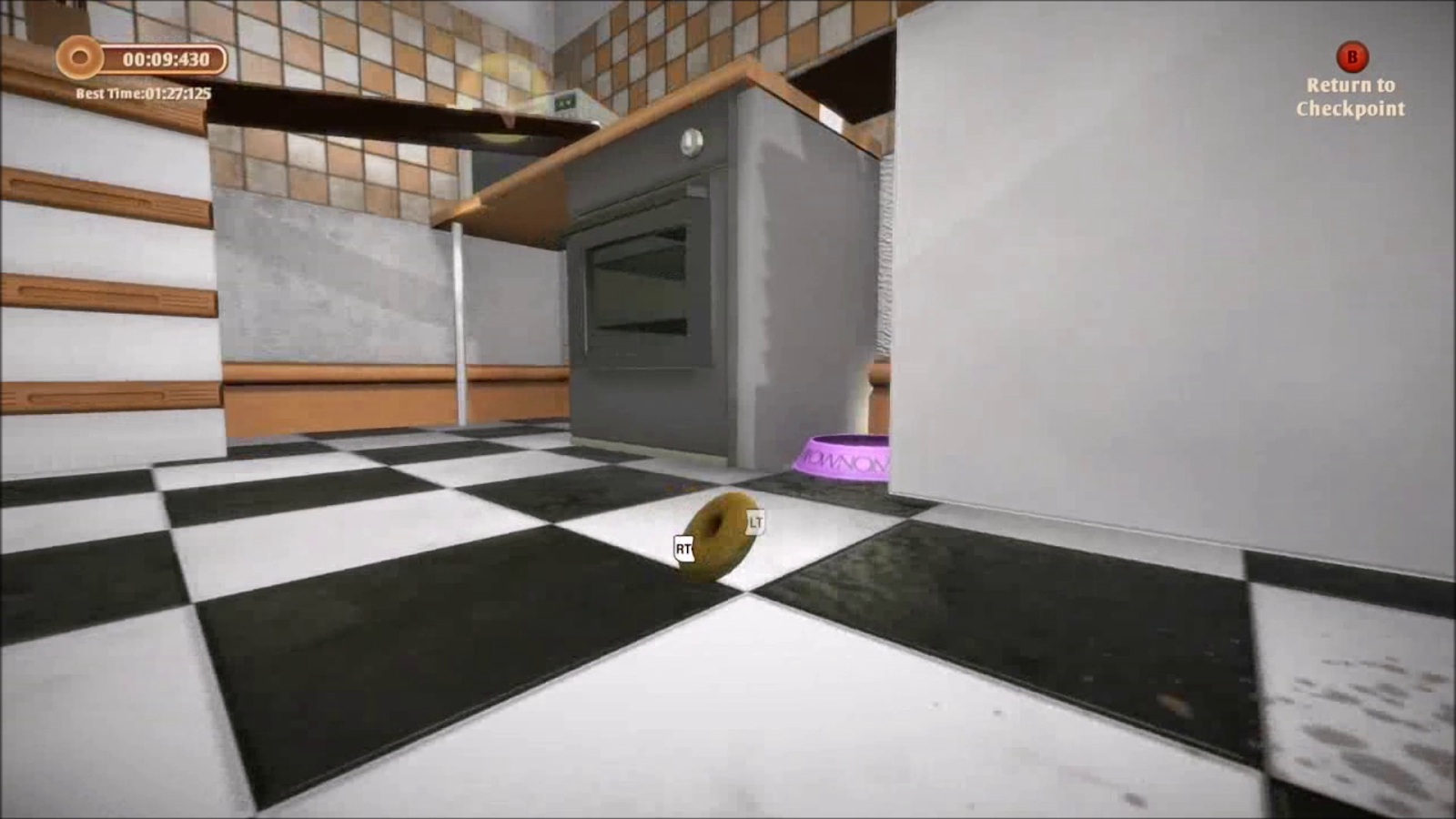
The bagel mode is called Bagel Race and is exactly that - using the two control points on your bagel you must roll yourself through the course, which is marked by glowing checkpoints. In addition to having to master steering and maneuvering, the bagel requires some serious rhythm and patience in order to learn the best way to build up speed and complete the course in the frankly cruel times the game sets for you.
The baguette mode is known as Rampage Mode - in which you are given a few minutes to roll around and smash everything in sight - often there’s precariously placed towers of glasses and objects lined up in a domino formation just waiting for your crusty self to plow through. However unlike the bread and crispbread cracker, the baguette only has two “corners” to control, so you often end up either rolling along your side or flipping over end to end. Smashing objects consecutively leads to increasing score multipliers which naturally awards you with higher grades upon completion.
The crispbread cracker mode is known as Cheese Hunt - and instead of having an edibility meter, you have an integrity meter. The crispbread cracker can smear itself through oil, grease and ants no problem - but fall from too high of a drop or hurtle into a breakable object like a plate or butter dish and you will begin to crack and shatter until you fall to pieces. The object of this mode is to find the pieces of cheese that are hidden throughout the level. The scoring aspect is all based on time, so once you’ve explored the levels top-to-bottom and have worked out the best route to nab all of the pieces in the fastest time, the only obstacle in your way is your own fragility. The cracker controls in a very similar manner to the bread, but is a lot stiffer and rigid - and of course, will break if dropped, where the bread’s inherent sponginess cushions blows but easily absorbs liquids.
The Team Fortress 2 mode invites you to create your own Edible Sandvich Device - navigating around familiar territory and even using classic objects from the game such as the Inflatable Balloonicorn and the sleeping Heavy to avoid touching the floor and make it to the fridge where the other ingredients are.
The Goat Simulator homage replaces the baguette in the Rampage Mode, instead renaming it to RAM-page Mode - and mapping four buttons to each of the goat’s limbs. It’s a great tribute to the frankly hilarious and impossible ragdoll physics of Goat Simulator itself and the goat really has some realistic weight to it - such as the back legs being a lot sturdier and stronger to move yourself around with than the front legs. While not being able to control it directly, the goat’s trademark tongue also flops around and can grip onto objects for extra destructive fun.
The Starch Wars is a space shooter simulator very similar to the likes of Lylat Wars, only set in the I Am Bread universe and the zero-gravity mode is exactly how it sounds - you control a slice of bread who is wearing a jetpack - and all of the ordinary level items, obstacles and hazards are now floating around in the air. I’m not a fan of zero gravity mode whatsoever - call me a sucker for integrity but I demand some believable aspects to my anthropomorphic bread simulator game, thank you very much. There is also a free roam mode, in which you can explore the levels to your heart’s content - finding Easter Eggs and secrets you may have missed on your first run through of a level as you were too busy watching the clock and clinging to the skirting board for dear life so as not to touch the dirty socks on the floor. Each level includes at least one hidden achievement and there are truly some bizarre and oddly hilarious things you can do, despite being a piece of bread. Can bread drive a car? Of course it can. Can it ride a skateboard? Yup. Can it soar through the air while stuck to the side of a rocketship? I’ll leave that one up to you to find out.
I recommend I Am Bread to anybody who is a fan of the more off-the-wall and absurd indie game scene on Steam, anyone who is a fan of hilarious and nonsensical gems like Goat Simulator, Octodad and Viscera Cleanup Detail - those of us who are spurred on by the impossible challenges set for us by fiendish developers who mock us if we score less than a B grade… For those of us who like to master peculiar control schemes and who like to think outside of the box… the bread box, that is!
Cosmic Spacehead is a game released in 1993 by Codemasters for the Sega Mega Drive. It's actually a re-release of a NES game called Linus Spacehead's Cosmic Crusade released in 1991 with shiny, new 16-bit graphics, fixed glitches and a 2-player mode. It's quite a unique concept, sections of open-ended world exploration with point-and-click adventure style puzzles with each world screen broken up by 2D side-scrolling platforming. Set in around the year 4000, Cosmic Spacehead is a young alien boy who has just returned from visiting planet Earth, and has come back to his home planet of Linoleum only to find out that nobody believes him because he has no proof. So Cosmic sets out to re-visit Earth, this time armed with a camera so that he can take snapshots of New York city and rub them in everyone's faces. The point-and-click puzzle sections are pretty basic, but after a while, can require backtracking half way around the planet in order to find the right items and the right places to use them. Using the C button, your puzzle approaches are limited to 5 different actions: "TALK TO," "USE," "GIVE," "PICK UP" and "LOOK AT." The vast majority of the puzzles are a bit roundabout, such as using icing sugar to freeze a stream to create a new pathway and building a tactical missile to clear away debris. But when interacting with objects, Cosmic will give you his own opinions on rude post office clerks and vending machines that sell gunpowder. The side-scrolling platform sections are encountered the first time you leave a screen and attempt to enter the next area. These start out basic, simply avoiding walking eggs and hopping across floating platforms, but gradually get more and more complex, resulting in the player having to time their jumps to avoid being electrocuted or to adjust to changing gravity levels. During the side-scrolling levels, Cosmic can collect cosmic candy bars - 10 of which will award you with an extra life. One of the awkward gameplay mechanics of Cosmic Spacehead is that it uses the archaic password system. These passwords are marked by big colourful Ps found in the main city and town areas. However, if you feel that you are doing well for lives, items and money, they can be ignored and returned to at a later stage to be used when you really need them. Using a password point will record all of your cleared levels, solved puzzles and you will retain all of your items and money.
The Mega Drive's 16-bit graphics aren't exactly pushed to their limit, but all of the characters and enemies are unique, colourful and full of personality. The pre-rendered backgrounds range from the jazzy, multi-coloured patterns of the planet Linoleum to the bleak, abandoned areas of the planet Detroitica, which has been overrun by its robot workers. The overly colourful and psychadelic graphics have often been likened to 60s cartoons such as The Jetsons. For some reason, Cosmic Spacehead also has a 2-player mode. I'll admit that I was disappointed with this. What I wanted was a 2-player co-op style adventure like Sonic The Hedgehog 2. What I got was a regurgitated version of a car driving mini game from the main single player game. Each player drives a bumper car around a maze and tries to throw custard pies at each other. If you have a Mega Drive, I really reccomend investing in a copy of Cosmic Spacehead. Being over 20 years old now, it's virtually impossible to find new, but I managed to grab a copy of it, with a box, booklet and a poster for only £3. I had it as a child and had been itching to play it again for around 12 years. Being a cartridge game, it's stood the test of time very well. From start to finish, if you know what you're doing. you can look for about 2 hours of gameplay - but if you get stuck looking for the plug for the bathtub or keep losing all of your lives in the Space Station, possibly longer.